





ALL-TERRAIN TYRES
Forty-six all-terrain tyres, 15 through 22 inch. Sixteen inch is the biggest block by some way, twenty-two of the forty-six — 265/70R16, 265/75R16 and 285/75R16 between them cover most of the utes and wagons on New Zealand roads — with 17, 18 and 20 inch above that. Twenty-five of the forty-six are 10-ply or reinforced, which is what you want if the ute actually works for a living.

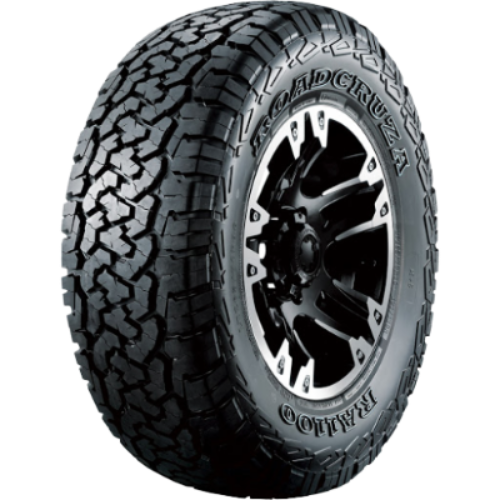 Roadcruza
255/70R16
111T · RA1100
All TerrainSymmetric
TYRE ONLY
Roadcruza
255/70R16
111T · RA1100
All TerrainSymmetric
TYRE ONLY Maxxis
Order in
255/70R16
111T
All TerrainSymmetric
TYRE ONLY$380
FITTED + BALANCED
FITTED
$420
VIEW TYRE
Maxxis
Order in
255/70R16
111T
All TerrainSymmetric
TYRE ONLY$380
FITTED + BALANCED
FITTED
$420
VIEW TYRE
 Maxxis
Order in
255/70R16
120S
All TerrainSymmetric
TYRE ONLY$535
FITTED + BALANCED
FITTED
$575
VIEW TYRE
Maxxis
Order in
255/70R16
120S
All TerrainSymmetric
TYRE ONLY$535
FITTED + BALANCED
FITTED
$575
VIEW TYRE
An all-terrain tyre runs a 25–35% void ratio — about a third of the tread is groove. That is enough to clear gravel, sand and light mud without giving up the highway manners you need for the other 70% of your driving. If you are in deep mud most weeks, you want a mud-terrain instead.
- Gravel is where an AT earns its money. New Zealand has roughly 45,000 km of unsealed road, and this is the tyre built for the mix.
- Expect 50,000–70,000 km if you rotate every 8–10,000 km.
- Air down to 15–18 PSI for soft sand, then reinflate before you touch seal again.
- Load rating matters more than brand on a loaded ute. Read the door placard, not the marketing.
What an all-terrain is, in one paragraph
An all-terrain runs about 70% road, 30% off it. The tread carries roughly a quarter to a third groove — enough to clear gravel, water and light mud, enough rubber still on the road to stop and steer properly in the wet. That is the whole trade-off, and for most 4WDs in this country it is the right place to sit.
The two we sell most of
We are the exclusive New Zealand distributor for both. They sit at opposite ends of the range — one built for punishment, one built for value — and between them they cover most of what people ask for.

New Mutant X-AT
Exclusive NZ distributor

USA-engineered by Transamerica Tire Co and proven at King of Hammers, the toughest off-road race there is. A 3-ply sidewall and the “SPIKE” dual sidewall design are the reason it survives sharp rock where a two-ply casing does not.
Where the X-AT publishes a UTQG grade it reads 500 A B, and on the 265/70R16 and 265/50R20 it is 520 A A. Treadwear of 500 means five times the wear rate of the baseline test tyre; the A traction grade is one step below the top.

AC858
Exclusive NZ distributor · built with Yokohama
Developed with Yokohama Rubber Company, the world’s seventh-largest tyre maker. Reinforced carcass, convex sidewall, and four deep curved grooves that evacuate water and clean themselves out. Lab work is ISO 17025 certified.
| Rated | AC858 | What it tells you |
|---|---|---|
| UTQG treadwear | 520 | Better than five times the wear rate of the 100 baseline tyre. |
| UTQG traction | A | Wet straight-line grip on asphalt and concrete. AA is the only grade above it. |
| UTQG temperature | A | Heat resistance at sustained speed — the top grade. |
| EU wet grip | C | Mid-table for wet braking. Honest for an all-terrain: tread that clears mud gives up wet tarmac. |
| Noise | 72 dB | About what an all-terrain should be. A quiet highway tyre is nearer 68. |
Ratings are the manufacturer’s own. Not every size publishes a UTQG grade — where the AC858 does, it is 520 A A, and wet grip and noise are listed on all of them. Whatever a given size carries is printed on its own product page.
Every brand in this range
Four brands, four different jobs. We are the exclusive New Zealand distributor for Predator and Anchee; the other two are here because they earn their place on price. No Hifly.
USA-engineered by Transamerica Tire Co. Advanced silica compound with deep multi-functional grooves, and a variable three-pitch pattern that keeps the road noise down.
Build: 3-ply sidewall, “SPIKE” dual sidewall
Rated: 50,000 mi + 4-year + road hazard included
Best for: Punishment. Sharp rock, long gravel, loaded utes.
21 in this range · from $285
Shop Predator →Developed with Yokohama Rubber Company, the world’s seventh-largest tyre maker. Reinforced carcass, convex sidewall, four deep curved grooves that clear water and self-clean. ISO 17025 lab certified.
Build: Reinforced carcass, convex sidewall
Rated: UTQG 520 A A where published · wet grip C · 72 dB
Best for: Yokohama engineering at a price most people can live with.
14 in this range · from $165
Shop Anchee →Belgian Bekaert steel belts — the same cord supplier the European brands use. Staggered shoulder lugs with wide grooves, all-season compound.
Build: 10PLY LT available
Rated: —
Best for: Maximum value. Weekend off-road on a budget.
3 in this range · from $190
Shop Joyroad →Canadian-designed with an aggressive block pattern and reasonable road manners. Available with outline white letters if you want the look.
Build: Aggressive shoulder blocks
Rated: UTQG 420 A B on the CF1000
Best for: Budget with attitude.
5 in this range · from $230
Shop Comforser →Side by side
| Tyre | Best for | Warranty | Price |
|---|---|---|---|
| Predator X-AT | Premium, and the only road hazard cover here | 50,000 mi + 4-year | $$$ |
| Anchee AC858 | Yokohama engineering at a budget price | UTQG 520 A A | $$ |
| Joyroad Adventure | Most tyre for the money | — | $ |
| Comforser CF1000 | Budget with the aggressive look | UTQG 420 A B | $ |
What actually sells
Six years of our own orders. Not a survey and not a guess — what people put in the basket and we shipped.
| Size | Share of all-terrain sales | What it usually goes on |
|---|---|---|
| 265/65R17 | 20% | Hilux, Ranger, D-Max |
| 265/60R18 | 19% | Ranger, Prado, Fortuner |
| 265/50R20 | 15% | Ranger, Amarok, late Hilux |
| 265/70R16 | 13% | Hilux, Navara, older 4WDs |
| 265/75R16 | 8% | Land Cruiser, Patrol |
| 245/70R16 | 7% | Prado, Pajero |
If you are on one of those, the odds are we have it on the shelf right now. If you are not, it is still worth asking — the long tail is a third of what we sell.
Which parts of the country buy them
Across everything we send out, a little over four in ten tyres are all-terrains. That share is not even across the country, and the split says a lot about how each region drives.
| Region | All-terrain share of its tyre orders | Against the national rate |
|---|---|---|
| Bay of Plenty | 51% | well above |
| Northland | 50% | well above |
| Waikato | 49% | well above |
| Manawatū-Whanganui | 47% | well above |
| Hawke's Bay | 42% | about average |
| Taranaki | 42% | about average |
| Auckland | 41% | about average |
| Wellington | 32% | below |
| Canterbury | 31% | below |
| Gisborne | 27% | below |
| Otago | 15% | below |
The top of that table is farm and forestry country — the Bay of Plenty, Northland and the Waikato all run about half their tyre buying on all-terrains. The bottom is city driving and sealed commuting, where a highway or passenger tyre does the job better and people buy accordingly.
Source: our own order history, 2020-2026. It counts online orders with a delivery address, so it under-represents counter sales and Te Puke pickups, and regions with too few orders to be meaningful are left out.
The sizes people actually ask for
The all-terrain sizes we are asked for most. Every one of these is in the range above — use the size finder at the top of the page to jump straight to it.
Or start from the wheel you are running:
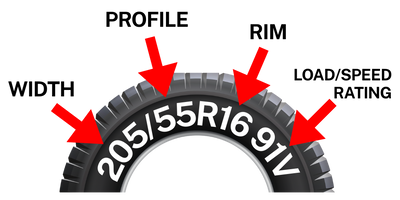
Not sure what you are running? The size is moulded into the sidewall and printed on the placard inside the driver’s door.
Find your sizeCommon questions
Are all-terrain tyres noisy on the motorway?
A little. Expect a few decibels over a highway tyre — noticeable at 100 km/h, not intrusive. Patterns with a variable pitch, where the block spacing changes around the tyre, are the quieter ones, because no single frequency builds up into a drone. The decibel figure is on every product page.
Is the price fitted, or tyre only?
Both, on every tyre here. Each one carries a TYRE ONLY price and a FITTED + BALANCED price, and you pick at the cart. Fitting runs $35 to $40 a tyre depending on the size, done at Te Puke. North Island delivery is free if you are fitting them yourself or using your own shop.
What pressure for the beach?
15–18 PSI in soft sand. That lengthens the contact patch so the tyre floats instead of digging. Reinflate before you get back on seal — a soft tyre at open-road speed builds heat in the sidewall and lets go. Carry a compressor.
All-terrain or mud-terrain?
Count your weekends. If you are in deep mud more than about one a month, go mud-terrain and accept the noise and the faster wear. Everyone else is better off on an all-terrain — it is the tyre that is good at the driving you actually do. Mud-terrain range →
Do I have to replace all four?
Not always, but the two on the same axle must match — same size, same construction, same pattern type. On a full-time 4WD, mismatched rolling diameters wind up the centre differential, so four is the safe answer there. On a part-time 4WD driven mostly in two-wheel drive, a pair is fine.
Will they pass a WOF?
Yes, like any tyre. The checks are 1.5 mm of tread across three quarters of the width, no cord showing, no bulges or splits, and load and speed ratings adequate for the vehicle. Chunked-out shoulder blocks from off-road use are the thing that catches people out on an all-terrain. See the tread depth guide.
Other ranges
Where this sits against everything else we stock.
Mud Terrain
Deep mud and rock
Rugged Terrain
The step between AT and MT

Highway Terrain
Quiet, sealed roads

4WD
HT vs AT vs RT vs MT

Light Truck
Vans, trailers, small trucks

All Tyres
The full range
Keep reading
The guides behind buying a tyre, written in the workshop.